
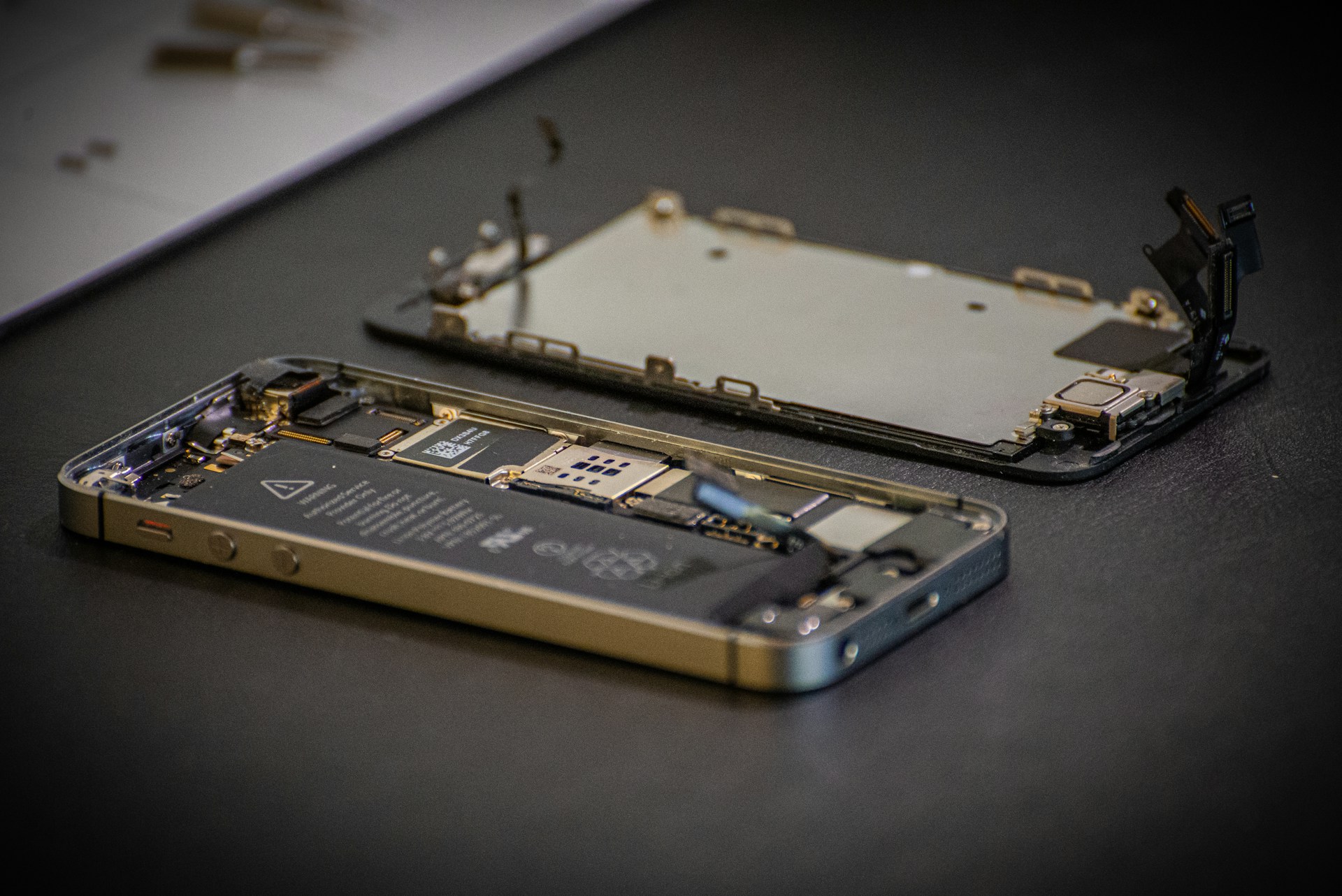
Ask any Singaporean how they would feel if their phone died right now, and you will get a reaction that is only half joking. Our phones hold our SingPass, our banking apps, our work Telegram groups, our kids’ school portal logins, and honestly, most of our memory as a society at this point.
Yet for something so central to daily life here, there has never really been a proper, honestly sourced look at how Singapore actually breaks, fixes, and replaces its phones. Most of what gets quoted online is either a global statistic dressed up to look local, or a number nobody can trace back to an actual source.
This report pulls together verified, publicly available data from Singapore government agencies, established market research firms, and a cross section of local repair providers, to build the most grounded picture currently available of how phone repair actually works in this country.
Where the data is genuinely Singapore specific, it is labelled as such. Where it is global and simply relevant context, that is stated plainly too. Every figure below links back to its original source so you can verify it yourself.
Singapore runs on more phones than people
Singapore’s mobile population penetration rate hit 165% in 2024, according to figures from the Infocomm Media Development Authority published through the Singapore Department of Statistics. To put that plainly, there are considerably more active mobile subscriptions in Singapore than there are people, a reflection of how common it is here to carry a personal phone alongside a separate work phone, or to keep an older device active on a second SIM.
This has climbed steadily over the past decade and a half. IMDA’s own historical data shows the penetration rate sitting around 143.6% back in 2010, which means Singapore’s relationship with mobile devices has intensified even as the population itself has grown. More devices in active daily use across more parts of daily life naturally means more devices eventually needing a repair, whether from a drop, a spill, or simple wear.
What is actually in Singaporeans’ pockets
According to Statcounter Global Stats, which tracks mobile vendor market share based on billions of monthly page views, Apple held 47.22% of the mobile vendor market in Singapore as of April 2026, more than double the next closest competitor. Samsung followed at 19.91%, with Xiaomi at 7.13%, Oppo at 5.74%, and Google at 3.96%.
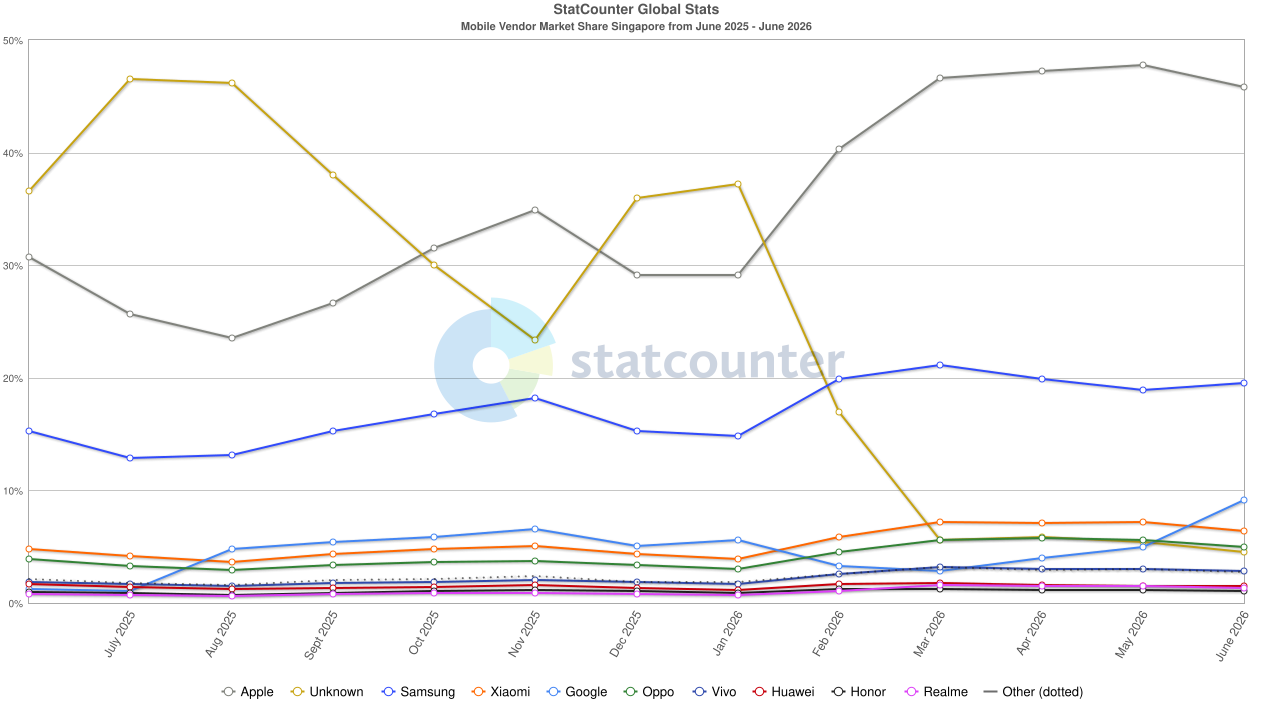
This lopsided split matters more than it might seem for anyone trying to understand the local repair market. It means demand for iPhone specific repairs, screens, batteries, charging ports, and Face ID related fixes, structurally outweighs Android repair demand by roughly two to one in Singapore, which is a noticeably higher Apple concentration than most other markets globally, where Android tends to dominate by a wide margin.
Any repair provider, insurer, or trade in service operating here needs to size their iPhone capacity accordingly, and any consumer comparing quotes should know that iPhone parts and labour here are priced against a market where Apple genuinely is the majority device, not a premium niche.
What actually breaks first
There is no publicly available Singapore specific breakdown of exactly which phone faults are most common here, and it would be dishonest to claim otherwise. What does exist is real, verifiable data from community repair events globally, collected and published by the Open Repair Alliance, based on an analysis of over 1,900 actual smartphone repairs. Their data shows screen related faults accounted for 41% of repairs, battery and other power related issues made up 15%, charging ports were involved in 6%, cameras in 3%, and speakers or microphones in a further 3% combined.
This lines up closely with what Singapore’s own repair providers describe anecdotally on their service pages, screens and batteries as the two most requested repairs by a clear margin, followed by charging issues and camera faults. It is reasonable directional context, even though it should not be quoted as a Singapore specific statistic, since the underlying data comes from global community repair events rather than a Singapore sample.
Singapore’s climate is not neutral in this story
Here is a genuinely local factor that almost nobody writing about phone repair mentions with any real data behind it. According to the National Environment Agency’s Weather Information Portal, Singapore’s long term mean annual rainfall between 1991 and 2020 was 2,113.3mm, spread across an average of 171 rain days a year. December is consistently the wettest month, sitting within the Northeast Monsoon’s wet phase that runs from November through January, when the seasonal rain belt sits closest to the region.
This is not a small detail. A country that rains on nearly half its days annually, combined with near constant high humidity and the daily habit of moving between air conditioned interiors and hot, humid outdoor air, creates conditions that are genuinely tougher on a phone’s internals than in most temperate markets.
Condensation inside a phone that has just come from an air conditioned MRT carriage into Singapore’s outdoor heat is a real, physically explainable phenomenon, and it sits on top of the more obvious risk of rain and accidental spills. While there is no published dataset directly tying Singapore’s monsoon calendar to repair shop volumes, the underlying physical conditions here make liquid and moisture related faults a structurally higher risk than in drier, cooler climates, and this is worth factoring into any honest assessment of local repair demand.
What Singaporeans are actually paying
Pricing is where a lot of confusion happens, mostly because most price lists online quote a single number without explaining the range. Pulling together publicly listed pricing from several established Singapore repair providers gives a clearer, more honest picture of what repairs genuinely cost here as of 2026.
Screen replacement is the most requested repair and the widest ranging in price. According to pricing published by myhalo, third party screen repairs in Singapore typically fall between SGD 150 and SGD 400, with the display technology itself, LCD versus OLED, being the single biggest driver of that spread. Independent research from Terris, a Singapore based service review site, breaks this down further by model generation, with older iPhones like the 12 and 13 typically running SGD 80 to SGD 150 for a screen at independent shops, while newer Pro Max models can range from SGD 200 to SGD 400 or more, and Samsung’s AMOLED heavy S series often lands in the SGD 220 to SGD 350 range.
Battery replacement is meaningfully cheaper and more consistent across providers. Litemobile’s published pricing places battery replacement between SGD 60 and SGD 150 depending on model, a range echoed closely by other providers surveyed. Charging port repairs generally sit in the SGD 80 to SGD 150 range, while camera repairs run higher, typically SGD 100 to SGD 300 depending on whether it is a single lens or a full multi camera module.
Water damage repair is the hardest to pin to a single number, and every provider surveyed is upfront about this. Litemobile places the starting point around SGD 100, climbing into several hundred dollars depending on how far corrosion has spread and how many components need replacing. This variability is exactly why water damage quotes only ever come after a proper inspection, not a flat price list.
Taken together, financial comparison site SingSaver’s analysis of iPhone repair economics makes a useful point that is easy to lose sight of. AppleCare Plus can bring a screen repair down to a fixed 42 dollars and other repairs to 148 dollars, but the subscription cost itself needs to be weighed against how likely you actually are to need a repair, since paying for a protection plan you never use is its own kind of loss.
The environmental angle nobody localises properly
According to a 2018 study by Singapore’s National Environment Agency, cited by ALBA E-Waste, Singapore generates roughly 60,000 tonnes of electronic waste annually, an amount the agency equated to every single person in Singapore discarding around 73 mobile phones worth of e-waste each year. Of that total e-waste stream, only 6 percent was being recycled at the time of the study.
More recent NEA data shows the country’s overall recycling rate held steady at 52% in 2025, with domestic recycling specifically sitting far lower at just 11%, according to NEA’s own waste statistics release. Singapore has since introduced a regulated e-waste management system under the Resource Sustainability Act, requiring producers of electronics to fund proper collection and recycling of their products, and mandating that larger retailers provide in-store e-waste collection points. It is a meaningful policy step, but the underlying consumer behaviour around treating a broken phone as disposable rather than repairable is still the bigger lever, and it is one individual repair decisions can genuinely move.
Every phone that gets repaired instead of replaced is one fewer contribution to that 60,000 tonne annual figure. This is not an abstract sustainability talking point, it is a direct, quantifiable consequence of a decision that gets made in Singapore homes and offices every single day.
What this actually means if your phone breaks
Put together, the picture that emerges is fairly clear. Singapore has one of the highest rates of mobile device use in the world, is unusually Apple heavy compared to most global markets, sits in a climate that is genuinely harder on phone hardware than most, and still recycles only a small fraction of the electronic waste it generates. Screens and batteries remain the overwhelming majority of what actually goes wrong, pricing across reputable providers is broadly consistent once you account for device tier and part quality, and the environmental case for repairing rather than replacing is backed by real, government sourced numbers, not marketing copy.
If there is one genuinely actionable takeaway from all of this, it is that a cracked screen or a fading battery in Singapore is rarely a sign that a phone is finished. Given how tightly Singapore’s device ownership, climate, and e-waste numbers all point in the same direction, a proper repair is very often still the more sensible option, both for the wallet and for everything sitting in that 60,000 tonne pile that a working phone would otherwise avoid joining.
Methodology and sources
This report draws exclusively on publicly available, independently verifiable data. Singapore specific government and statutory figures are sourced from the Infocomm Media Development Authority via data.gov.sg, the National Environment Agency, and the Singapore Department of Statistics. Market share data is sourced from Statcounter Global Stats. Global repair fault type data is sourced from the Open Repair Alliance’s published dataset of community repair events. Local pricing figures are aggregated from publicly listed pricing pages of established Singapore repair providers, cited individually throughout, current as of 2026. No figure in this report has been estimated, modelled, or generated without a traceable public source, and every source is linked at the point it is used so readers and other publishers can verify it directly.
If you are a journalist, researcher, or fellow publisher and would like to reference or build on this data, feel free to link back to this report as the source.

